

Apparently, I’m Your Reference
I get asked to be a reference in the kink community fairly often. Sometimes it’s someone I’ve played with, sometimes it’s someone I know socially, and sometimes it’s someone who has apparently decided I’m their reference without bothering to tell me. That’s always an interesting surprise, especially when I get a message asking about someone whose name I don’t recognize. I’ll look at their FetLife profile, study the photograph, and try to figure out who they are. Sometimes I come up with absolutely nothing.
Now imagine being the person checking references and hearing, “I’m sorry, but I have no idea who that is.” Not exactly the ringing endorsement you were hoping for, is it? And the thing is, I might actually know the person under a different name or recognize them if I saw them in person. But if I can’t figure out who they are, I’m certainly not going to pretend otherwise. That person may have just lost an opportunity to play with someone because they couldn’t be bothered to ask me first.
I’ve also had people handle it exactly the way they should. A former play partner once asked if he could list me as a reference on his FetLife profile. He hoped that having my name there would help him find other play partners, and I was perfectly happy to agree. He asked, I said yes, and we both knew what I was agreeing to. See how easy that was?
But not every request comes from someone who has been given my name as a reference. Sometimes people reach out because they’ve heard I might know someone or have played with them. They’re trying to get a better sense of who they’re dealing with, and they’ve heard my name mentioned somewhere along the way. Most of those conversations are pretty straightforward. There was one, though, that has stuck with me.
When the Answer Isn’t So Simple
Someone contacted me about a man I had known in the community. He had been a friend, and my personal experiences with him had always been positive. We’d gotten along, and I had no complaints about how he’d treated me.
But there’s more to that story.
I’d become aware of issues involving consent and boundary violations with other people. These weren’t minor disagreements or personality conflicts. They were serious enough that I made the decision to end our friendship and disassociate myself from him.
So here I was, being asked about someone I’d once considered a friend. Someone who had treated me well, but whose behavior toward others had changed how I viewed him and whether I wanted him in my life.
And I had to figure out how to answer.
I could have said that my experiences with him had been good and left it at that. It would have been completely true. But knowing what I knew, I wasn’t comfortable giving someone an answer that might leave them with the impression that I was recommending him without reservation. At the same time, I wasn’t going to claim that I’d personally experienced things I hadn’t, or start sharing details of other people’s experiences that weren’t mine to tell.
Ultimately, I told the person that my experiences with him had been positive, but that others had not had the same experience.
That was the truth. Not a particularly neat or reassuring answer, perhaps, but I wasn’t interested in making it sound prettier than it was.
Two Things Can Be True
I think most of us have encountered someone who seems like an entirely different person depending on who’s describing them. You listen to one person talk about how wonderful they are, then hear someone else describe an experience that makes you wonder if they’re even talking about the same individual.
And sometimes they’re both telling the truth.
That’s something I had to recognize with my former friend. My experiences with him were good. I enjoyed his company, and I had no reason to rewrite those memories just because I later learned things about his behavior that troubled me. But my positive experiences didn’t erase what happened to other people, either. The fact that he’d respected my boundaries didn’t mean he’d respected everyone else’s.
I think the temptation, especially when we’re talking about someone we like, is to fall back on “Well, they’ve always been good to me.” I’ve heard people say that about someone who’s been accused of behaving badly, almost as though their own positive experience settles the matter. And I understand why people might initially react that way. It’s difficult to reconcile the person you know with behavior you never witnessed.
But “they’ve always been good to me” tells you exactly that. How they’ve treated you. It doesn’t tell you how they’ve treated everyone else.
And that’s what I kept coming back to when I was answering that message. I wasn’t being asked to decide what kind of person he was for all eternity. Someone wanted information that might help them make a decision, and I had information that was relevant. Some of it came from my own positive experiences, and some of it involved knowing there had been serious concerns about his behavior toward others.
I wasn’t going to dismiss either.
What Am I Really Vouching For?
I’ve spent years building my reputation in the kink community, and I’m very aware that my name can carry weight when someone is looking for references. That’s one reason I’m careful about agreeing to provide them. I don’t want someone interpreting my name on a profile as some kind of Princess Rara seal of approval guaranteeing that everything will be wonderful.
I can tell you about my experiences with someone. I can tell you how they behaved when we played, what I observed, and what I thought of our interactions. But even if every experience I had with that person was fantastic, I can’t promise that yours will be. And if I know there are serious concerns beyond my own experiences, I don’t feel comfortable pretending those concerns don’t exist just because they didn’t happen to me.
There’s also a difference between sharing what I know and sharing someone else’s story. The people who experienced those consent and boundary violations didn’t give me their experiences to use as conversation material. I wasn’t going to turn their experiences into gossip, but I also didn’t feel that protecting their privacy meant I had to give an unqualified positive reference.
What the person ultimately decided, I have no idea. But that wasn’t the point of our conversation. My responsibility was to share what I knew honestly and let them decide what to do with that information.
What I could do was give them an honest answer and let them decide what to do with it.
Looking back, I wouldn’t change how I handled that conversation. I’m glad I didn’t dismiss the experiences of others simply because mine had been positive, and I’m glad I didn’t pretend my own experiences were something they weren’t. Both would have been dishonest in different ways.
I still get messages asking me about people, and I suspect I always will. Hopefully, more of them will come from people who have actually asked me to be their reference first. That would be a nice change!
But when someone does ask for my opinion, I want them to know that I’m going to tell them what I actually know, even when the answer is complicated. I can’t give anyone a guarantee about another person’s behavior, and I certainly can’t tell their entire story.
I can only tell you my part of it. And sometimes, knowing there’s more to the story is just as important.
Looking for More Guidance on Kink References?
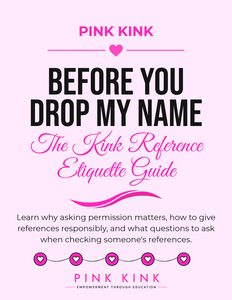
I’ve created Before You Drop My Name: The Kink Reference Etiquette Guide, a digital resource that explores asking permission before listing someone as a reference, providing references responsibly, and knowing what questions to ask when checking someone’s references.
You can find it in the Pink Kink Boutique on Etsy:
Before You Drop My Name: The Kink Reference Etiquette Guide
Want to hear more about kink references, including why you should always ask permission before listing someone, what makes a useful reference, and how to evaluate the information you’re given? Listen to Pink Kink Episode 297, “References in Kink: Who’s Vouching for You?” Available wherever you get your podcasts.